REFLECTIONS IN HEBREWS, AN EXHORTATION FOR PERSEVERANCE

Many view the book of Hebrews as a doctrinal book and it does contain many very helpful doctrinal truths but in the mind of its author, it was a letter of exhortation to believers. In 13:22 he says, “I beseech you, brethren, suffer the word of exhortation: for I have written a letter unto you in few words.”

When we consider the content of Hebrews we can conclude that it was written before the destruction of the temple in 70 A.D., because the writer of Hebrews makes reference to the temple service, the priests, and the sacrifices in the present tense. In the present tense, he makes a comparison between the superiority of Jesus’ ministry in the heavens (in the greater and more perfect tabernacle) to that which was on earth (which only served as a shadow and an example) to point men to Christ.

Many who continued in the old Jewish system rejected the Christian faith and persecuted the Jewish Christians. We see this play out in Paul’s ministry in the book of Acts. In Hebrews 10:32-34 the writer of Hebrews addresses it as well.

Think back on those early days when you first learned about Christ. Remember how you remained faithful even though it meant terrible suffering. Sometimes you were exposed to public ridicule and were beaten, and sometimes you helped others who were suffering the same things. You suffered along with those who were thrown into jail, and when all you owned was taken from you, you accepted it with joy. You knew there were better things waiting for you that will last forever. ~ Hebrews 10:32-34 TNLT

According to the author, his audience had suffered for their faith in Christ.

In chapter 2, he tells them that they are sanctified by Jesus as brethren to Christ and as the church. He goes on to say that Jesus is a faithful high priest for them: his brethren.

In 3:1, the author of Hebrews addresses his audience as holy brethren and partakers of the heavenly calling. He tells them that Jesus is the apostle and high priest of their profession of faith. This would no doubt be believers and not unbelievers.

Nowhere in the entire letter is he talking to unbelievers. He calls them brethren throughout the letter (2:11, 12, 17; 3:1, 12; 7:5; 10:19; 13:22). He also includes himself by using the pronouns we (51 times) us (31 times) and our (16 times). He also refers to his audience as “beloved” in 6:9.

The author of Hebrews tells them they are partakers of Christ’s house if they hold fast to the faith (3:6,14). In chapter 5 and 6 he admonishes them to move on from the elementary stages of the Christian faith to maturity.

For when for the time ye ought to be teachers, ye have need that one teach you again which be the first principles of the oracles of God; and are become such as have need of milk, and not of strong meat. For every one that useth milk is unskilful in the word of righteousness: for he is a babe. But strong meat belongeth to them that are of full age, even those who by reason of use have their senses exercised to discern both good and evil. ~ Hebrews 5:12-14

According to the author of Hebrews his audience was still living as babes in Christ in their spiritual growth and unable to teach others because they were not yet skillful in the word of righteousness. In chapter 6, he urges them to move on to perfection (i.e., spiritual maturity).

He admonished them regarding those who turn back (6:4-5) and declares that he is persuaded differently about them.

For the earth which drinketh in the rain that cometh oft upon it, and bringeth forth herbs meet for them by whom it is dressed, receiveth blessing from God: But that which beareth thorns and briers is rejected, and is nigh unto cursing; whose end is to be burned. But, beloved, we are persuaded of better things of you, and things that accompany salvation, though we thus speak. ~ Hebrews 6:7-9

Verse 9 (above) speaks volumes of the author’s view of those to whom he is writing. Though he gives them repeated warnings concerning the danger of apostasy, he constantly affirms them as believers and admonishes them to persevere in their faith. Notice verses 10-12 which follows the previous verses of Hebrews 6:7-9 above.

For God is not unrighteous to forget your work and labour of love, which ye have shewed toward his name, in that ye have ministered to the saints, and do minister. And we desire that every one of you do shew the same diligence to the full assurance of hope unto the end: That ye be not slothful, but followers of them who through faith and patience inherit the promises. ~ Hebrews 6:10-12 

Again, notice how the author of Hebrews mixes admonition with encouragement. Encouragement that God has not forgotten, and admonishment not to give up but to persevere until the end.

Exhortation mixed with admonition is weaved all throughout the letter to the Hebrews as he repeatedly explains to them, and admonishes them concerning the importance of perseverance in the faith.

Later in his letter (chapter 11) he speaks of many of the Old Testament saints who persevered in faith, referring to them as “a great cloud of witnesses,” as he urges his audience to lay aside every weight and the sin that so easily besets them. He tells them to run with patience the (spiritual) race that is set before them as they look to Jesus the author and finisher of our faith.

He also admonishes them concerning the chastisement of the Lord which comes through in the stern warnings given in his letter as he reminds them to whom they belong.

For ye are not come unto the mount that might be touched, and that burned with fire, nor unto blackness, and darkness, and tempest, And the sound of a trumpet, and the voice of words; which voice they that heard intreated that the word should not be spoken to them any more: (For they could not endure that which was commanded, And if so much as a beast touch the mountain, it shall be stoned, or thrust through with a dart: And so terrible was the sight, that Moses said, I exceedingly fear and quake:). Ye are come unto Mount Zion, and unto the city of the living God, the heavenly Jerusalem, and to an innumerable company of angels, to the general assembly and church of the firstborn, which are written in heaven, and to God the Judge of all, and to the spirits of just men made perfect, And to Jesus the mediator of the new covenant, and to the blood of sprinkling, that speaketh better things than that of Abel. ~ Hebrews 12:22-24

He exhorts them to not refuse him who speaks from heaven but rather to have grace so that they will serve God acceptably with reverence and godly fear: For our God is a consuming fire. ~ 12:25-29

As he begins to close his letter (chapter 13) he tells them to do the following:

  • continue in brotherly love
  • entertain strangers
  • remember those who are in prison
  • remember those who are being mistreated
  • be faithful in marriage
  • do not love money
  • remember God’s promise to never fail or leave them
  • remember those who have taught them the word of God and follow their faith
  • do not be carried away by various and strange doctrines
  • establish your hearts in grace
  • bear the Lord’s reproach (i.e., suffer for his name)
  • offer the sacrifice of praise to God continually in the name of Jesus
  • don’t neglect doing good to the needy
  • submit to those who are their leaders in the Lord
  • continue praying for him (the writer) and those with him.

Finally, he closes his letter with the following words:

Now the God of peace, that brought again from the dead our Lord Jesus, that great shepherd of the sheep, through the blood of the everlasting covenant, Make you perfect in every good work to do his will, working in you that which is wellpleasing in his sight, through Jesus Christ; to whom be glory for ever and ever. Amen. And I beseech you, brethren,suffer the word of exhortation: for I have written a letter unto you in few words. Know ye that our brother Timothyis set at liberty; with whom, if he comes shortly, I will see you. Salute all them that have the rule over you, and all the saints. They of Italy salute you.  Grace be with you all. Amen.
REFLECTIONS IN HEBREWS – THE TABERNACLE

Now when these things were thus ordained, the priests went always into the first tabernacle, accomplishing the service of God. But into the second went the high priest alone once every year, not without blood, which he offered for himself, and for the errors of the people: The Holy Ghost this signifying, that the way into the holiest of all was not yet made manifest, while as the first tabernaclewas yet standing… ~Hebrews 9:6- 8

Impactful truths can be missed when reading the book of Hebrews if we are not following the flow of thought being expressed by the writer. This is especially true in the middle portion of the epistle, because he speaks of things which Bible students may feel they have a background knowledge in, and consequently the student may actually miss what is being said.

Take for instance, the tabernacle. I had always read the words, the first tabernacle, in verse 8 as a reference to the entire tabernacle of Moses (the outer court, the inner court, and the Holy of Holies). However, as I pondered the teaching in Hebrews regarding the Holy of Holies, my understanding was opened and I realized I had been reading this text wrong. 

It dawned on me that the writer of Hebrews refers to each tented compartment within the tabernacle of Moses, as a tabernacle. He uses the term tabernacle, to refer to the Holy Place and the Most Holy Place. He calls the Holy Place, the first tabernacle, and he calls the Holy of Holies the second tabernacle.

Then verily the first covenant had also ordinances of divine service, and a worldly sanctuary. For there was a tabernacle made; the first, wherein was the candlestick, and the table, and the shewbread; which is called the sanctuary. And after the second veil, the tabernacle which is called the Holiest of all… ~ Hebrews 9:1-3 

Now even the first covenant had regulations for divine worship and the earthly sanctuary. For a tabernacle was equipped, the outer sanctuary, in which were the lampstand, the table, and the sacred bread; this is called the Holy Place. Behind the second veil there was a tabernacle which is called the Most Holy Place… Hebrews 9:1-3 ~ NASB

The Amplified Bible says, Behind the second veil there was another tabernacle [the inner one or second section] known as the Holy of Holies…

The Berean Literal Bible says, Now behind the second veil was a tabernacle, being called the Holy of Holies.

The writer of Hebrews viewed each tented compartment of the tabernacle as a tabernacle. So when he mentions the first tabernacle in verse 6, we should follow his flow of thought and understand that he is referring to the inner court, and not the complete structure that we know as the tabernacle of Moses (the outer court, inner court, and Holy of Holies).

This clarification is a key component in understanding what the writer of Hebrews is teaching us regarding the High Priestly Ministry of Jesus and the new and living way that is opened to us through Jesus.

Under Moses, the High Priest entered alone, once a year. But into the second went the high priest alone once every year, not without blood, which he offered for himself, and for the errors of the people… ~ v 7 

Under the law, the lone entrance by the High Priests into the Most Holy Place (the 2nd tabernacle) was the continual reminder that reconciliation had not yet come. This correlates with what the writer of Hebrews will tell us in chapter 10 regarding the sacrifices offered by the High Priests.

But in those sacrifices there is a remembrance again made of sins every year. ~ Hebrews 10:3

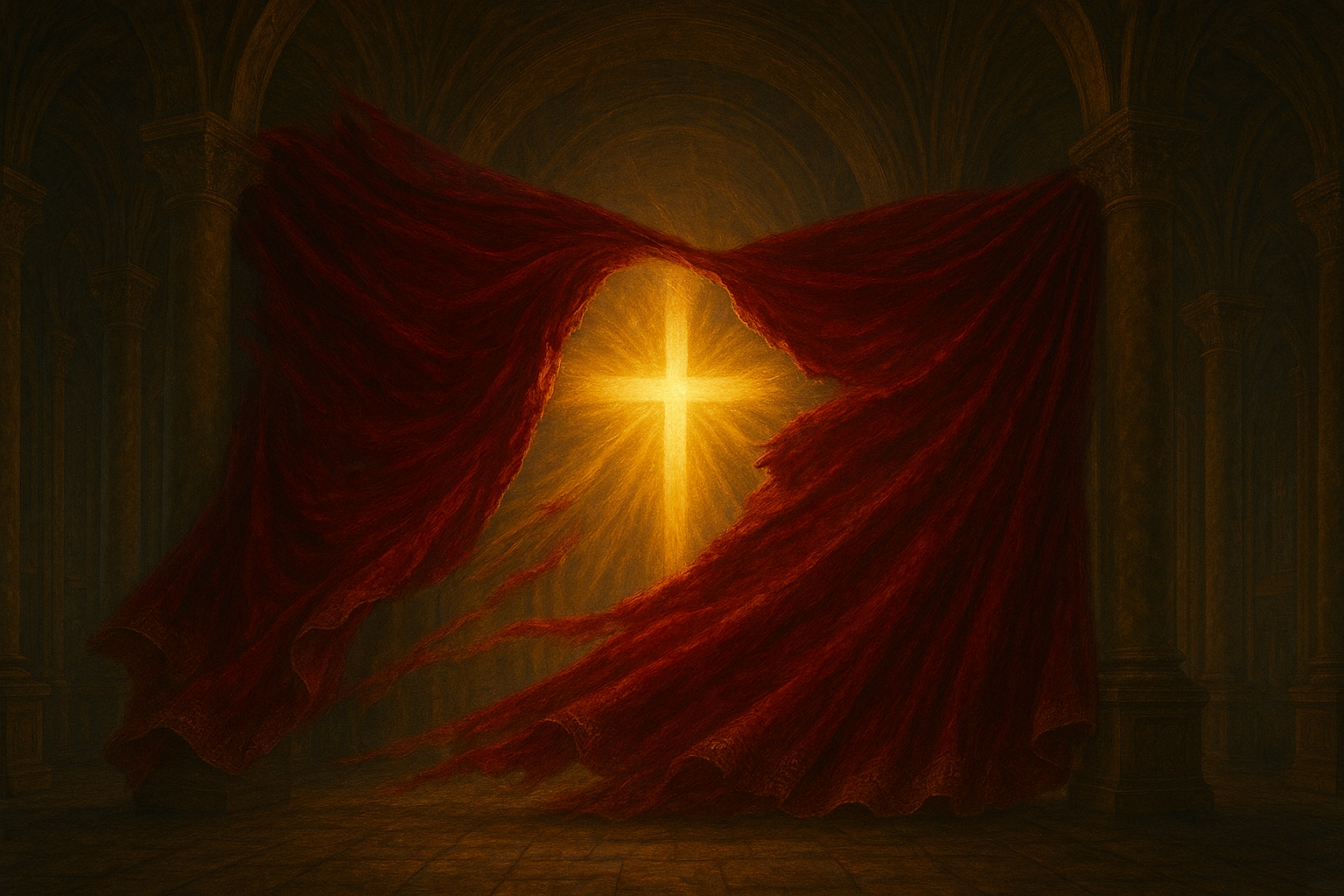
In contrast, Jesus entered the Most Holy Place in Heaven with no intention of staying there alone, because he put away sin by the sacrifice of himself (9:26). The separating veil has been removed through Jesus who came in the flesh and dwelt, (“tabernacled”) among us. Through Jesus, the holy place (the believer’s walk of faith), and the Most Holy Place (Christ in the presence of God), have become one with no separating veil.

Through the Holy Spirit the two compartments have become one, and we can dwell daily in the presence of God through the Spirit that our Heavenly Father has bestowed on us through the Son who is the radiance of his glory.  

REFLECTIONS IN HEBREWS ~ APOSTLE AND HIGH PRIEST

Wherefore, holy brethren, partakers of the heavenly calling, consider the Apostle and High Priest of our profession, Christ Jesus… ~ Hebrews 3:1

The word apostle means sent one, and as the apostle of our faith, Jesus is the sent one from God. He is the very face of God to us. In Jesus we have all that our faith needs to comprehend the character and nature of God. When we consider the actual ministry of the apostles whom Jesus discipled and ordained, along with the ministry of Paul, we find that the apostles were entrusted with laying the foundation for New Testament doctrine, worship, and practice.

Thus the apostleship of Jesus speaks to the truth that Christ is the founder of the faith, the One who laid the very foundation of our faith. This is echoed in Hebrews 12:2, where the writer of Hebrews encourages us to run our spiritual race with patience, looking unto Jesus the author and finisher of our faith.

In the following verse (12:3), the writer says, For consider him that endured such contradiction of sinners against himself, lest ye be wearied and faint in your minds. This is the same language he uses when speaking of Jesus as the apostle and High Priest: consider the Apostle and High Priest of our profession, Christ Jesus.

As apostle, Jesus is the author of our faith. As High Priest he is the finisher. As our Great High Priest Jesus abides in the presence of God to aid us, keep us, and daily cleanse us by his blood. He is our intercessor and representative, who lives forever to make intercession for us (7:25). Jesus’s is God’s guarantee to us that what he has began in us, he will bring to its completion.

Because of Jesus abiding in the presence of God as our representative, we have unrestricted access to the grace and mercy we need as we journey through life in the walk of faith. Jesus is the apostle (the founder), and High Priest (the finisher) of our faith!

May God grant us all a deeper understanding of what it means that Christ is indeed our Apostle and High Priest.

AMERICAN CHRISTIANITY GONE WRONG

You have attracted people who are determined that ideology is more important than facts. ~ Ted Koppel to Sean Hannity. 

In the United States, there is a clash between the facts that non Christian people see and experience and the ideology of many Christians, especially  white Christians.

Rather than being the light of the world (John 5:14) that Jesus called us to be, the ideology of many Christians has intensified the rejection of Christianity among our fellow citizens. Rather than being light to their fellow Americans, many American Christians are at war with them.

The light we are called to be as Christians is expressed in the traits that Jesus reveals in the sermon on the mount, which we often refer to as the Beattitudes. Being meek, poor in spirit, merciful, pure in heart, and peacemakers never once caused anyone outside the faith to blaspheme.

The culture wars that many American Christians have engaged in against their fellow citizens is steeped in right winged politics rather than the truth that is in Christ.

Consider the title of a podcast I recently came across as two Christian rightwingers engaged in political conversation about “Christian warfare” against the left. I have changed the name of the person to American Christian Activist, because my point is not to bring attention to any one particular person, but the mindset behind American Christian ideology. The title said:

American Christian Activist EXPOSES the “Love your neighbor” Fake Christianity.

When loving your neighbor is met with contempt, true motives are revealed. Ironically, Jesus employed the truth of loving your neighbor many times, and he did so to expose the hypocrisy of those who presented themselves as spiritual people. The story of the Good Samaritan is a visual illustration given by the Lord of glory regarding what loving your neighbor actually looks like.

Unfortunately, the ideology of many American Christians who like to use terms such as “biblical” to defend their culture war positions, looks nothing like the model Jesus gave us in the Good Samaritan.

Rather than being a light to the world around us in true holiness and the fear of the Lord, many American Christians have embraced a persecution mentality and feel threatened by the lifestyles of their fellow American citizens, and rather than showing kindness and mercy, they have chosen to engage in culture wars against their neighbor. 

In this ideology the Bible no longer points them to fear of a Holy God in true humility, but the sacred scriptures now serve as their political guide book for justifying the hatred they have for their neighbor. 

BETWEEN THE CHERUBIMS

Under the Old Testament, the Ark of the Covenant was made of acacia wood (a very durable wood) and overlaid with gold. The combination of these two materials (wood and gold) points us to Jesus who was both human and divine. The word was made flesh, and we beheld his glory. Wood and gold express the divine and human nature of Christ in one.

Within the Ark, Moses placed the Ten Commandments, a pot with some of the manner which came down from Heaven, and Aarons rod, or staff which blossomed as a sign to the people of Aarons’s authority as the one God had chosen as Priest. Jesus is the Ark of God, for in him the law is fulfilled, he is the true bread from Heaven, and he is the chosen one with all authority and power as our Great High Priest.

The Ark also had the crown of pure gold and no wood, because the Kingship of Jesus is based on his divinity. He is the King from above. Seated inside of the crown was the covering of the Ark which was called the Mercy Seat. The Mercy Seat was made of pure gold and had two cherubims (angels) made of beaten work on its two ends.

18 And thou shalt make two cherubims of gold, of beaten workshalt thou make them,in the two ends of the mercy seat. 19 And make one cherub on the one end, and the other cherub on the other end:even of the mercy seat shall ye make the cherubims on the two ends thereof. ~ Exodus 25:18-19

Beaten work is actually hammered work in the Hebrew. As Jesus was making his way to the cross he could have asked the Father for more than twelve legions of angels to deliver him, but such a request would not have fulfilled the scriptures.

52 Then said Jesus unto him, Put up again thy sword into his place: for all they that take the sword shall perish with the sword. 53 Thinkest thou that I cannot now pray to my Father, and he shall presently give me more than twelve legions of angels? 54 But how then shall the scriptures be fulfilled, that thus it must be? ~ Matthew 26:52-54

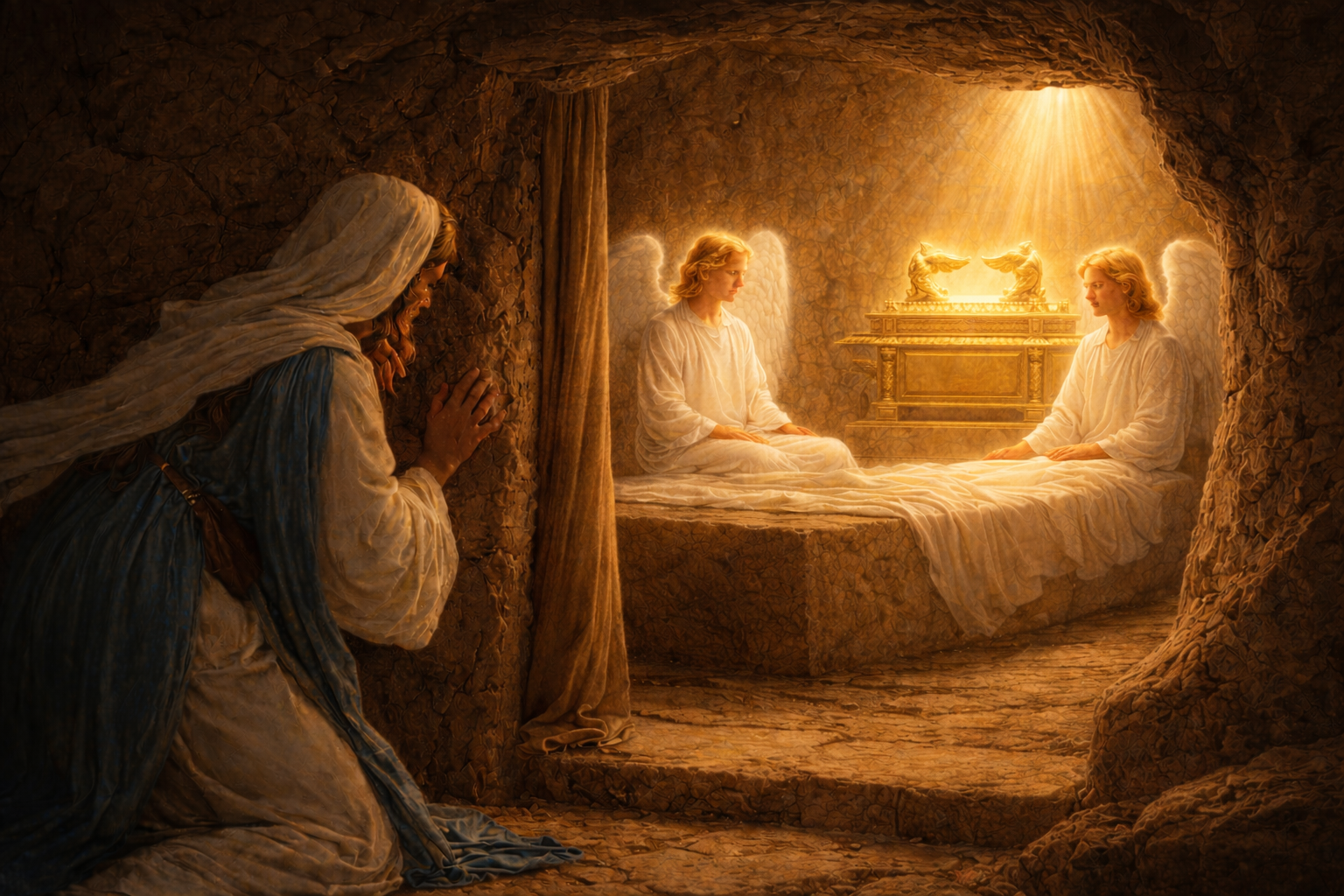
The scriptures would not have been fulfilled if the angels had delivered Jesus from the cross. Jesus had to die on the cross by nails being hammered through his hands and feet, and on the morning that he was raised from the dead, Mary weeping, looked into the tomb where the body of Jesus had been laid. To her astonishment she did not see the Lord’s body, but she did see two angels – one at the head, and one at the feet where the body of Jesus had been laid. She saw the fulfilment of the mercy seat.

11 But Mary stood without at the sepulchre weeping: and as she wept, she stooped down, and looked into the sepulchre, 12 And seeth two angels in white sitting, the one at the head, and the other at the feet, where the body of Jesus had lain. ~ John 20:11-12 

God’s words to Moses regarding the cherubims were, “thou shalt make two cherubims of gold, of beaten workshalt thou make them, in the two ends of the mercy seat. And make one cherub on the one end, and the other cherub on the other end:even of the mercy seat shall ye make the cherubims on the two ends thereof.” ~ Exodus 25:18-19 

What God gave to Moses as the pattern of Heavenly things, Mary saw in its fulfillment.

The Psalmist tells us that God dwells between the Cherubims.

Give ear, O Shepherd of Israel, thou that leadest Joseph like a flock; thou that dwellest between the cherubims, shine forth. ~ Psalm 80:1

The resurrection of the crucified, bloodied body of Jesus, is the shinning forth of God’s mercy, bringing hope and salvation through the risen Christ!

CHRIST IN THE OLD TESTAMENT ~ BEAUTY FOR ASHES

The Spirit of the Lord God is upon me; because the Lord hath anointed me to preach good tidings unto the meek; he hath sent me to bind up the brokenhearted, to proclaim liberty to the captives, and the opening of the prison to them that are bound; To proclaim the acceptable year of the Lord, and the day of vengeance of our God; to comfort all that mourn; To appoint unto them that mourn in Zion, to give unto them beauty for ashes, the oil of joy for mourning, the garment of praise for the spirit of heaviness; that they might be called trees of righteousness, the planting of the Lord, that he might be glorified. ~ Isaiah 61:1-3

WOW! There is a lot in this set of scriptures. Just reading it is inspiring. If you are in a place where you feel somewhat cold in your relationship with the Lord, these verses can help stir your heart once again.

With that said, I want to draw your attention to the phrase,“beauty for ashes.”

Nearly 25 years ago, I returned to the Bible College that I had graduated from close to a decade earlier, and I had the privilege of teaching the students on the topic of Christ in the Old Testament. The things I am about to share with you are taken from my notes which I used to teach on this important topic. I hope to share more from my notes at a later time.

When God instructed Moses to construct the tabernacle, he said to him: See to it that you make everything according to the pattern shown to you on the mountain. ~ Exodus 25:40

The tabernacle was the dwelling place of God in the midst of his people Israel, and later in Israel’s history the temple built by Solomon would become the central focus.

Everything in the tabernacle and later in the temple were divinely orchestrated. The decor, the furnishings, the ministry of the priests, and the sacrifices was so divinely inspired that in the tabernacle the gospel of Christ was hidden in the midst of the Israelites as they journeyed in the wilderness and eventually entered into the promised land.

The writer of Hebrews tells us For unto us was the gospel preached, as well as unto them:but the word preached did not profit them, not being mixed with faith in them that heard it. ~ Hebrews 4:2

The gospel was preached to the Israelites, and the tabernacle was filled with revelation of the coming Messiah. For example, the sacrifices which were offered on the altar of sacrifice in the tabernacle all point to Christ in various ways. The offerings consisted of the burnt offering, the grain offering, the peace offering, the sin offering, and the trespass offering.

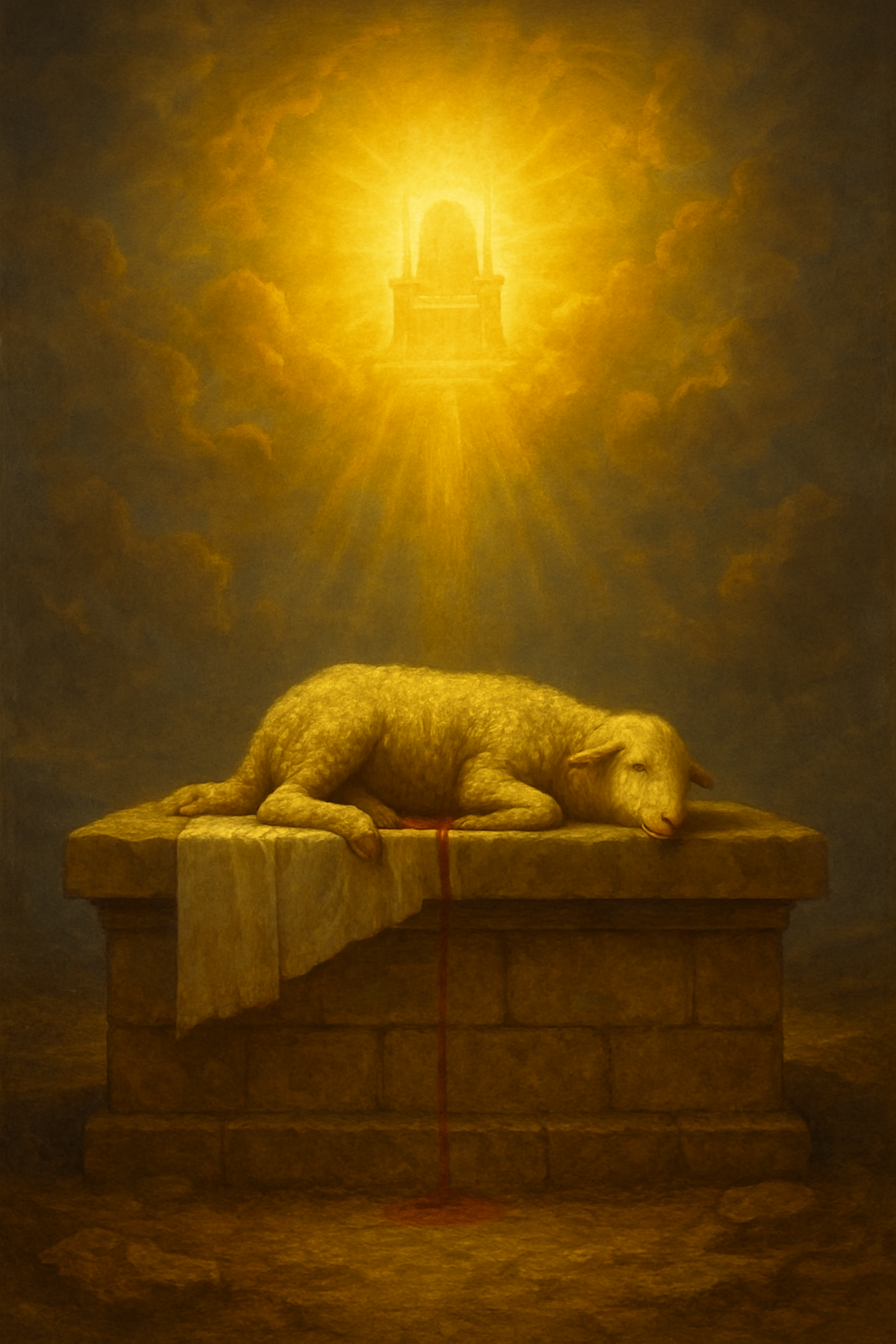
The burnt offering, unlike the other offerings, was wholly consumed. This represented Christ who was completely given to the will of God, and was wholly committed to laying down his life for us when he died on the cross. Jesus held nothing back, he gave himself entirely! That was foreshadowed in the burnt offering which was also called “the whole burnt offering.”

The burnt offering is the most prominent of all the offerings and the more we learn about this offering the more we will understand the power in the others and how they foreshadowed Christ. In like manner, the more we know of the person of Christ, the more we will grasp the greatness of his work in laying down his life for us. 

When we consider the ashes that accumulated from the burnt offerings, as well as all the other offerings which give us a portrait of Christ, we quickly learn that the ashes carry a divine message of “it is finished.”  

Christ allowed himself to be reduced to ashes on our behalf, holding nothing back and giving himself wholly. He is now crowned with honor and glory and sits at the right hand of God. The same God that accomplished his purpose in and through Christ giving him beauty for ashes (a throne for a cross) will also exalt us in Christ and with Christ, as we die to our old selves and surrender to him. This is the work of His Holy Spirit in our lives.

Our God, the God and Father of our Lord Jesus Christ, truly gives beauty for ashes, and Christ is the living, breathing representation of that reality.

Under the Old Testament, the burnt offerings, the grain offerings, and the peace offerings were considered voluntary offerings. Conversely, the sin and trespass offerings were compulsory offerings. The first three were freely given by the worshipper, testifying to us that Jesus voluntarily gave himself for us, and freely served the Father to do his will.

On the other hand, the sin and trespass offering were required offerings because they involved the atonement for sins. Though Christ willingly gave himself to die for our sins, the compulsory nature of the sin and trespass offering teaches us that there was no other way for our sins to be cleansed. Christ had to die!

Now before we take a deep dive into the burnt offering, let’s look a little further into the other two voluntary offerings. First, let’s consider the grain offering (aka, the meat offering in the KJV).

This offering (as unleavened bread) foreshadowed the sinless humanity of Jesus Christ. Jesus is the unleavened bread who gave his flesh for our sins. Below is a list of facts that you will find in the Old Testament, particularly the book of Leviticus, regarding this grain offering.

  • It was unleavened. 
  • It was offered with flour and frankincense.
  • It was voluntarily offered.
  • It was most holy (Christ was without sin though tempted at all points in the flesh). 
  • Oil was poured on it, (a type of the anointing of Spirit in Christ’s humanity).
  • It was an offering made by fire. (Christ endured the fiery crucible of the crucifixion in his flesh). 
  • It was seasoned with salt. (Salt is a preservative, and though Christ suffered severely in the flesh he was preserved by God’s righteousness).
  • It was sweet fragrance. Christ’s humanity was pleasing to God.
  • It made provision for both the poor and the rich. (No one is outside of the scope of the saving power of the man, Jesus Christ, He died for all).
  • It was offered with the daily sacrifices. (The daily sacrifices were burnt offerings and we will cover this when we circle back to the burnt offerings). 
  • It was an offering of consecration, preservation, and purity. Consider 2 Kings 3:20; Joel 1:8-9,13; 2:12-14
  • It foreshadowed Christ’s sinless humanity(2 Co 5:21; Heb 4:15), and that Christ’s body did not decay in the tomb (Acts 2:30-31; 13:33-34). 

One of the beautiful truths about the grain (meat) offering is that it sanctifies. In Leviticus 2 which covers the law of the grain offering, we also read about a new grain offering.

No meat offering, which ye shall bring unto the Lord, shall be made with leaven: for ye shall burn no leaven, nor any honey, in any offering of the Lordmade by fire. As for the oblation (offering) of the firstfruits, ye shall offer them unto the Lord: but they shall not be burnt on the altar for a sweet savour. ~ Leviticus 2:11-12

Notice that these verses above speak of two separate offerings. One is to be offered without leaven on the altar, the other is to be offered to the Lord, but not on the altar, and it is called the offering of the first fruits which was one of the feasts of the Lord that Israel was to celebrate.

Consider the following from Leviticus 23.

Even unto the morrow after the seventh sabbath shall ye number fifty days;
and ye shall offer
a new meat offeringunto the Lord. Ye shall bring out of your habitations two wave loavesof two tenth deals; they shall be of fine flour; they shall be baken with leaven;they arethe firstfruits unto the Lord. And ye shall offer with the bread seven lambs without blemish of the first year, and one young bullock, and two rams: they shall be for a burnt offering unto the Lord, with their meat offering, and their drink offerings, even an offering made by fire, of sweet savour unto the Lord. Then ye shall sacrifice one kid of the goats for a sin offering, and two lambs of the first year for a sacrifice of peace offerings. And the priest shall wave them with the bread of the firstfruits for a wave offering before the Lord,with the two lambs: they shall be holy to the Lordfor the priest. ~ Leviticus 23:16-20

The new meat (i.e., grain) offering was offered fifty days after the feast of first fruits, which followed the feast of unleavened bread, which followed Passover. Christ was crucified on the 14th day of the month of Nisan which was the first month on the Jewish calendar, (see Ex 12:6,14,18,19; Numbers 9:2; 28:16; Deuteronomy 16:1; Joshua 5:10; Ezekiel 45:21). He was then buried and his body rested in the tomb as the unleavened bread on the 15th which was the first day of the seven day feast of unleavened bread. Then on the next day (the 16th) was the feast of first fruits which signified the resurrection of Jesus. Then 50 days later there was Pentecost. It was during the time of Pentecost that the new meat (grain) offering was to be offered to the Lord. This would be an offering that had not been offered on the altar of sacrifice, and would consist of two loaves made with leaven.

In the New Testament, Peter on the Day of Pentecost stood up and preached the gospel of the Messiah to his kinsmen in the flesh, and those who believed from the two houses (Judah and Israel) became one as they were sanctified in the Messiah. The two loaves with leaven became the firstfruits of the salvation that would later spread to the entire world.

The foreshadowing of the two leavened loaves would have an even wider application as the believing Jews would soon understand that Jesus did not die only for the people of Israel. He died for the whole world, and there is no doubt that the two loaves (the new grain offering) made with leaven, represent the union of the Jews and Gentiles who are presented as an offering to God through Jesus Christ. Because of Christ, we who are sinners (the leavened loaves) are made holy being sanctified by the blood and Spirit of Jesus Christ.

In his letter to the Romans, the apostle Paul seems to draw on this marvelous truth when he writes the following:

Nevertheless, brethren, I have written the more boldly unto you in some sort, as putting you in mind, because of the grace that is given to me of God, That I should be the minister of Jesus Christ to the Gentiles, ministering the gospel of God, that the offering up of the Gentiles might be acceptable, being sanctified by the Holy Ghost. ~ Romans 15:15-16 

Notice the language of the offering up of the Gentiles. In Christ Jesus, we are made an offering to God for his glory and honor. We who have believed from among the Jews and Gentile are the leavened loaves that have been sanctified by the perfect lamb of God and are now seated with Christ in Heavenly places. And this was foreshadowed in the tabernacle in Old Testament where the revelation of Christ was divinely hidden in a mystery.

Would you like to hear more? If so, leave a comment.

FROM HOLY TO THE MOST HOLY

And the Lord spake unto Moses after the death of the two sons of Aaron, when they offered before the Lord, and died; And the Lord said unto Moses, Speak unto Aaron thy brother, that he come not at all times into the holy place within the vail before the mercy seat, which is upon the ark; that he die not: for I will appear in the cloud upon the mercy seat. ~ Leviticus 16:1-2

We often refer to the three areas of the tabernacle as the outer court, the inner court, and the Holy of Holies. When doing so, the distinction is often made between the inner court and the Holy of Holies as the holy place (the inner court) and the Most holy place (the Holy of Holies).

Now, the scriptures do not always use this language, so it is vitally important that we follow the context and the flow of thought to correctly understand which part of the tabernacle is being referenced in a given text. Leviticus 16:1-2 referenced above, is a perfect example.

Notice the mention of the holy place, which is a description often used to refer to the inner court. However, this text is not referring to the inner court, but the Most holy place. We know this because of the context. Aaron the High Priest, is warned not to come into this Holy place except for the appointed time, and this holy place is referred to as the holy place within the vail before the mercy seat. So the holy place referred to in this text is the Most Holy place where the glory of God rested on the mercy seat.

In contrast to the once a year entrance into the Most Holy Place, Aaron (the High Priest) was to minister daily in the inner court which is also referred to at times as the holy place.

Now, there is a traditional error that states that on the Day of Atonement the high priest entered the Holy of Holies with a rope tied around him in case he were to die in the presence of God. According to this teaching, the people would understand that the high priest had fallen dead because they would cease to hear the bells on the robe of the high priest and therefore they could retrieve his dead body with the rope tied around him without having to go into the Holy of Holies. This has been taught by many ministers, but it is entirely unscriptural, and is an extra Biblical rabbinical teaching. It is not found in scripture.

Now, let’s back up a little to get the wider picture. In Exodus 28 we are given a detailed description of the priestly garments worn by Aaron the high priest in his daily ministration within the service of the tabernacle. These garments consisted of the ephod, the curious girdle of the ephod, the breastplate of judgment, the robe (all blue) of the ephod, the mitre (bonnet) with the plate of gold, the linen coat, and the line breaches. This is the full attire of Aaron’s High Priestly garments, as well as his successors.

The garment of blue was the garment which had bells and pomegranates on the hem of it. It was this garment that made a sound that could be heard by those outside the tabernacle, but this garment was not worn into the Most Holy Place on the Day of Atonement, as we will see later in this article, but first let’s consider Aaron’s service in the inner court and the garment of blue which had the bells and the pomegranates.

And thou shalt make the robe of the ephod all of blue. And there shall be an hole in the top of it, in the midst thereof: it shall have a binding of woven work round about the hole of it, as it were the hole of an habergeon, that it be not rent. And beneath upon the hem of it thou shalt make pomegranates of blue, and of purple, and of scarlet, round about the hem thereof; and bells of gold between them round about: A golden bell and a pomegranate, a golden bell and a pomegranate, upon the hem of the robe round about. And it shall be upon Aaron to minister: and his sound shall be heard when he goeth in unto the holy place before the Lord, and when he cometh out, that he die not. ~ Exodus 28:31-35

This text is one of the references that might be used to promote the teaching that the High Priest entered the Holy of Holies on the Day of Atonement with a rope tied around him because of the use of the words, “before the Lord.” This text however, is not referring to the Most holy Place but the the inner court. The language, “before the Lord,” is used for the altar of sacrifice in the outer court, just as it is for the inner court and the Holy of Holies.

When the High Priest burned incense at the altar of incense, which was in the Holy place (the inner court), it was said to have been done before the Lord.

And thou shalt make an altar to burn incense upon: of shittim wood shalt thou make it. A cubit shall be the length thereof, and a cubit the breadth thereof; foursquare shall it be: and two cubits shall be the height thereof: the horns thereof shall be of the same. And thou shalt overlay it with pure gold, the top thereof, and the sides thereof round about, and the horns thereof; and thou shalt make unto it a crown of gold round about. And two golden rings shalt thou make to it under the crown of it, by the two corners thereof, upon the two sides of it shalt thou make it; and they shall be for places for the staves to bear it withal. And thou shalt make the staves of shittim wood, and overlay them with gold. And thou shalt put it before the vail that is by the ark of the testimony, before the mercy seat that is over the testimony, where I will meet with thee. And Aaron shall burn thereon sweet incense every morning: when he dresseth the lamps, he shall burn incense upon it. And when Aaron lighteth the lamps at even, he shall burn incense upon it, a perpetual incense before the Lord throughout your generations. Ye shall offer no strange incense thereon, nor burnt sacrifice, nor meat offering; neither shall ye pour drink offering thereon.

Notice that Aaron was to minister at this altar, every morning, and every evening. This was the part of the daily ministry of Aaron as the High Priest, and it is the place of ministry which Exodus 28 is referring to when it speaks of the robe of blue which had the bells and the pomegranates on the hem of it. The bells were separated by pomegranates because without them, the bells could make an unpleasant sound clanging together. Paul seems to allude to this in 1 Corinthians 13 when he says, Though I speak with the tongues of men and of angels, and have not charity, I am become as sounding brass, or a tinkling cymbal. ~ 1 Corinthians 13:1

Without the fruit of God’s love, being gifted with spiritual endowments bear little to no lasting fruit for God’s Kingdom. When the high priest ministered in the holy place (not the Holy of Holies) the bells with the pomegranates would make a pleasant sound and the High Priest was heard within the tabernacle as he daily carried out his service in the holy place (the inner court). However, on the Day of Atonement, the High Priest wore only the linen garments into the Holy of Holies. He did not wear the full attire of his beautiful priestly garments which included the garment of blue which had the bells and pomegranates. In Leviticus 16, which details the ministry of the High Priest on the Day of Atonement, we read the following:

He shall put on the holy linen coat, and he shall have the linen breeches upon his flesh, and shall be girded with a linen girdle, and with the linen mitre shall he be attired: these are holy garments; therefore shall he wash his flesh in water, and so put them on. ~ Leviticus 16:4

And Aaron shall come into the tabernacle of the congregation, and shall put off the linen garments, which he put on when he went into the holy place, and shall leave them there… ~ Leviticus 16:23

And the priest, whom he shall anoint, and whom he shall consecrate to minister in the priest’s office in his father’s stead, shall make the atonement, and shall put on the linen clothes, even the holy garments… ~ Leviticus 16:32

On the Day of Atonement, Aaron and his successors wore only the linen garments, and not the full attire of the Priestly garments which were worn in the daily ministrations of their office. In the book of the Revelation we find that linen garments represent, the righteousness of the saints (Revelation 19:8).

The laying aside of the full attire of the Priestly beautiful garments, and being clothed in only the linen garments, speaks to the powerful truth that when Jesus entered into this world he laid aside his glory and majesty and humbly took on human flesh, becoming servant. Paul tells us in the book of Philippians that Jesus was in the form of God, and being equal with God made himself of no reputation, and took upon him the form of a servant, and was made in the likeness of men: And being found in fashion as a man, he humbled himself, and became obedient unto death, even the death of the cross. ~ Philippians 2:6-8 

When Jesus entered the presence of God for us after his death on the cross, he did so in his pure and humble humanity. In this manner, he made intercession for us, having obtained eternal redemption for us with his own blood.

Now before we close, I would like to draw your attention to another truth that could easily be missed when reading the book of Hebrews. In Hebrews 9, the writer of Hebrews mentions all the furniture in the Holy place (the inner court), and the Most Holy Place (the Holy of Holies), except for one of the furnishings. He mentions the table of showbread, the lamp stand, and the Ark of the Covenant with the mercy seat as its covering. There is no mentioned of the altar of incense.

Is this an oversight, or is something else going on here that we need to see? I am persuaded that the writer of Hebrews intentionally leaves out the altar of incense because Hebrews 9 is written with the Day of Atonement in view. On the Day of Atonement incense was taken from the altar of incense into the Most Holy Place with the golden censer which the writer of Hebrews mentions instead of the altar. Thus the writer of Hebrews is attempting to take us from the Holy place which was preparatory, into the Most Holy because of the finished work of Christ.

For there was a tabernacle made; the first, wherein was the candlestick, and the table, and the shewbread; which is called the sanctuary (the inner court). And after the second veil, the tabernacle which is called the Holiest of all; Which had the golden censer, and the ark of the covenant overlaid round about with gold, wherein was the golden pot that had manna, and Aaron’s rod that budded, and the tables of the covenant; And over it the cherubims of glory shadowing the mercyseat; of which we cannot now speak particularly. ~ Hebrews 9:2-5

Notice that he associates the golden censer with the Holiest of all, rather than the Holy place where the High Priest ministered daily at the altar of incense. Leviticus 16, which details the ministry of the High priest on the Day of Atonement, tells us exactly what the writer of Hebrews is telling us.

And he shall take a censer full of burning coals of fire from off the altar before the Lord, and his hands full of sweet incense beaten small, and bring it within the vail: And he shall put the incense upon the fire before the Lord, that the cloud of the incense may cover the mercy seat that is upon the testimony, that he die not… ~ Leviticus 16:12-13

When Jesus died on the cross, the veil of the temple was torn from top to bottom (Matthew 27:51; Mark 15:38; Luke 23:45). The incense from the altar of incense represents prayer (Revelation 8:3), but no prayer but that of our High Priest could bring an end to that which separated humanity from a Holy God. Jesus is the High Priest, who took the incense (the prayers for salvation, deliverance, and redemption) from the Holy place into the Most Holy, (Heaven itself) having secured our permanent redemption with his own blood.

As we read the following in closing, keep in mind some of the things which we have covered in this article.

Now when these things were thus ordained, the priests went always into the first tabernacle, accomplishing the service of God. But into the second went the high priest alone once every year, not without blood, which he offered for himself, and for the errors of the people: The Holy Ghost this signifying, that the way into the holiest of all was not yet made manifest, while as the first tabernacle was yet standing: Which was a figure for the time then present, in which were offered both gifts and sacrifices, that could not make him that did the service perfect, as pertaining to the conscience; Which stood only in meats and drinks, and divers washings, and carnal ordinances, imposed on them until the time of reformation. But Christ being come an high priest of good things to come, by a greater and more perfect tabernacle, not made with hands, that is to say, not of this building; Neither by the blood of goats and calves, but by his own blood he entered in once into the holy place, having obtained eternal redemption for us.  For if the blood of bulls and of goats, and the ashes of an heifer sprinkling the unclean, sanctifieth to the purifying of the flesh: How much more shall the blood of Christ, who through the eternal Spirit offered himself without spot to God, purge your conscience from dead works to serve the living God? ~ Hebrews 9: 6-14 

May the Lord increase our understanding. Blessings.

WHEN I CONSIDER THE HEAVENS… WHAT IS MAN THAT YOU ARE MINDFUL OF HIM?

The Psalmist wondered as to the significance of humanity in the thoughts of God in view of God’s greatness and the works of his hands.

When I consider thy heavens, the work of thy fingers, the moon and the stars, which thou hast ordained; What is man, that thou art mindful of him? For thou hast made him a little lower than the angels, and hast crowned him with glory and honour. Thou madest him to have dominion over the works of thy hands; thou hast put all things under his feet… ~ Psalm 8:3-6 

Among the many quotations from the Old Testament that the writer of Hebrews cites to speak of the magnificence of Christ, this is one of them.

For unto the angels hath he not put in subjection the world to come, whereof we speak. But one in a certain place testified, saying, What is man, that thou art mindful of him? or the son of man that thou visitest him? Thou madest him a little lower than the angels; thou crownedst him with glory and honour, and didst set him over the works of thy hands: Thou hast put all things in subjection under his feet. For in that he put all in subjection under him, he left nothing that is not put under him. But now we see not yet all things put under him. But we see Jesus, who was made a little lower than the angels for the suffering of death, crowned with glory and honour; that he by the grace of God should taste death for every man. ~ Hebrews 2:5-9

Andrew Murray writes, “It was by his union with us in our life in the flesh, by his identifying himself with our nature, that Jesus was able to claim and to work out and enter into possession of the glory God had promised to man.”

Have you ever thought about this in such a way, that Jesus has possessed the glory that God prepared for man created in his image? In Jesus we find all the fulness of what God has prepared for us.

We are living in a time in which false teachers prey on unsuspecting Christians by appealing to their need for a meaningful Christian life. This is often presented as destiny, and is often tied to donating to the false teachers’ ministry. The Bible never presents such doctrines to us. 

The goal of the Christian life is to be daily conformed to the image of Christ, to allow the Holy Spirit’s work to transform us more into the likeness of Christ. Paul says to the Colossians, ye are complete in him, which is the head of all principality and power… ~ Colossians 2:10.

This comes on the heels of Paul’s words to be firmly rooted and built up in Christ and not to have our faith in Christ supplanted through philosophy and vain deceit, after the tradition of men, after the rudiments of the world… ~ 8

In Christ, God has brought forth the perfect image of himself in humanity, and the likeness of Christ is what the Holy Spirit works within our inner life, moment by moment, as we fix our gaze of him and trust him with all our hearts.

As we consider the vastness of God’s creation, and the heavens declaring the glory of God, think how rich, and deep, and glorious his work in us by His Spirit must be, as he transforms us into the very likeness of Christ through our journey of faith?

Blessings…

HEBREWS STUDY OUTLINE

HEBREWS: A LETTER OF EXHORTATION

“I appeal to you, brothers, bear with my word of exhortation…” — Hebrews 13:22


Hebrews Is a Book of Exhortation

  • A letter written to encourage believers to persevere in faith.

Hebrews Is a Book of Warnings

  1. Warning not to neglect our great salvation.
  2. Warning not to harden our hearts against the Holy Spirit.
  3. Warning not to become slothful.
  4. Warning not to draw back into apostasy.
  5. Warning of sin and rejection of Jesus.

Hebrews Is a Book of Comparisons

  • Jesus is greater than the prophets.
  • Jesus is greater than the angels.
  • Jesus is greater than Moses.
  • Jesus is greater than Joshua.
  • Jesus’ priesthood is greater than the priesthood of Aaron.
  • The new covenant is greater than the old.
  • The blood of Christ is greater than the blood of animals.

Hebrews Is a Book of Redemption Themes

  • The sufferings and exaltation of Jesus Christ.
  • The high priestly ministry of Christ.
  • The new covenant.
  • The blood of Christ.
  • The reward for enduring faith.

OUTLINE OF HEBREWS

1. The Son Revealed (Ch. 1)

  • The Son in whom God speaks is greater than the prophets (1:1–2).
  • The glory of the Son (1:3).
  • The superiority of the Son to angels (1:4–7).
  • The exaltation of the Son (1:8–14).

2. First Warning

  • Do not neglect our great salvation (2:1–3).
  • God’s power confirming the gospel – a foretaste of the world to come (2:4–5).
  • Humanity lower than angels (2:6–8).
  • Jesus’ humanity and suffering for us (2:9–10).
  • Jesus accepts us as His brethren (2:11–13).
  • Jesus defeated the devil (2:14–15).
  • Jesus is the seed of Abraham (2:16).
  • Jesus is a merciful and faithful high priest (2:17–18).

3. Jesus, Our Apostle and High Priest (Ch. 3–4)

  • Jesus is faithful to God (3:2).
  • Jesus is greater than Moses (3:3–6).

Second Warning:

  • Do not grieve the Holy Spirit or harden your hearts (3:7–15).
  • Israel’s failure in the wilderness because of unbelief (3:16–19).
  • Entering God’s true Sabbath rest: the finished work of Christ (4:1–11).
  • Nothing hidden from Christ (4:12–13).
  • Our great high priest in the heavens (4:14–16).

4. Jesus the Perfect High Priest (Ch. 5–7)

  • The ministry of the high priest (5:1–4).
  • Christ called and perfected as high priest (5:5–11).

Third Warning:

  • Against slothfulness leading to apostasy (5:11–6:12).
  • Spiritual growth and the Word of God (5:12–14).
  • The principles of the doctrine of Christ (6:1–3).
  • Qualifications for permanent apostasy (6:4–8).
  • God’s faithfulness and encouragement (6:9–11).
  • Abraham as an example of faith and patience (6:12–15).
  • God’s promises and oaths give strong confidence (6:16–18).
  • Jesus in the presence of God is our hope (6:19–20).
  • Christ’s priesthood after the order of Melchizedek (7:1–24).

5. The New Covenant and the Blood of Christ (Ch. 8–10)

  • Jesus’ more excellent ministry (8:1–6).
  • The old covenant replaced by the new (8:7–13).
  • Earthly sanctuary and sacrifices as shadows of Christ (9:1–10).
  • Christ fulfills the foreshadowing (9:11–15).
  • Only Jesus’ blood can take away sin (9:18–22; 10:1–4).
  • Christ came to do God’s will (10:5–14).
  • The Holy Spirit testifies to Christ’s finished work (10:15–18).
  • Invitation to draw near to God by the blood of Jesus (10:19–22).
  • Exhortations to persevere in faith (10:23–25).

Fourth Warning:

  • Against willful sinning and drawing back (10:26–39).

6. Enduring Faith and Godly Living (Ch. 11–13)

  • The faith of the great cloud of witnesses (11:1–12:1).
  • Jesus, the author and finisher of our faith (12:2–4).
  • The Lord’s chastening (12:5–11).
  • Exhortation to press on in faith (12:12–14).

Fifth Warning:

  • Beware of sin and rejecting Jesus (12:15–29).

7. Practical Exhortations (Ch. 13)

  • Continue in brotherly love.
  • Show hospitality to strangers.
  • Remember prisoners and the mistreated.
  • Be faithful in marriage.
  • Be free from the love of money; trust God’s promise.
  • Remember and follow faithful leaders.
  • Avoid strange doctrines; establish hearts in grace.
  • Bear Christ’s reproach.
  • Offer the sacrifice of praise to God continually.
  • Do good and share with the needy.
  • Submit to godly leaders.
  • Pray for the writer and his companions.

Closing:

  • Benediction and encouragement (13:20–21).
  • Appeal to accept the letter as a word of exhortation (13:22).
  • Final greetings and blessing (13:23–25).

The Priesthood of Jesus: A Devotional Study Series (Part 5)

KING AND PRIEST

A priest is not a priest without a sacrifice, and a King is not a King without a throne. Jesus is our Priest King,

Introduction

By all evidence, the book of Hebrews was written before the destruction of the temple in 70 A.D. The writer refers to the temple, the priests, and the sacrifices in the present tense, showing these services were still ongoing. Yet he contrasts them with Christ’s greater ministry in the heavens—in the “greater and more perfect tabernacle”—revealing the earthly system as only a shadow pointing to Christ.

The writer explains that if Jesus were on earth, He would not be a priest, since there were already priests serving according to the Law. Even so, that priesthood was rendered ineffective by Christ’s finished work on the cross and by His ongoing ministry as our High Priest in heaven.

When the temple was destroyed in 70 A.D., the Levitical priesthood—already superseded by Christ—became completely inoperative.


THE LAW OF A CARNAL COMMANDMENT

Under the Law of Moses, only descendants of Aaron from the tribe of Levi could serve as priests. Jesus, however, is from the tribe of Judah—of the royal line of David—about whom Moses said nothing regarding priesthood (Hebrews 7:12–14).

The writer of Hebrews calls this priestly appointment “the law of a carnal commandment” (Hebrews 7:16–18), declaring it annulled because it was weak and unprofitable. Since the priesthood changed, the Law itself had to change (Hebrews 7:12).

Without priests to mediate between God and the people, the Law could not function. The priests themselves were mortal, sinful, and unable to bring people near to God. Hence, the Law “made nothing perfect” (Hebrews 7:19–23).


JESUS OUR APPOINTED PRIEST

Unlike the mortal priests of the Law, Jesus lives forever as our High Priest. He was appointed by the oath of God after being raised from the dead (Hebrews 7:21–22).

God promises never to revoke His oath concerning Jesus as our High Priest.

“The Lord has sworn and will not repent: You are a priest forever…” (Psalm 110:4)

Because of this irrevocable oath, Jesus is the guarantee of a better covenant—our eternal hope.


CHRIST: PRIEST AFTER THE ORDER OF MELCHIZEDEK

Jesus’ priesthood is not after Aaron’s line, but “after the order of Melchizedek” (Hebrews 7:11).

This phrase describes the rank and structure of His priesthood:

  • Like Melchizedek, Jesus is both King and Priest—something not permitted under the Law of Moses.
  • Unlike the Aaronic priests, His priesthood is eternal and unchanging.
  • Jesus’ work is finished, and He is seated at the right hand of the Majesty on High (Hebrews 8:1).

THREE WAYS MELCHIZEDEK IS PRESENTED IN SCRIPTURE

Bible teacher Ruth Lasalle Specter observed that Melchizedek appears in three ways:

  1. In HistoryGenesis 14:17–23
    • First priest mentioned in Scripture.
    • Lived 400+ years before the Law and 1,000 years before the prophecy of Psalm 110.
  2. In ProphecyPsalm 110:4
    • “The Lord has sworn and will not repent: You are a priest forever after the order of Melchizedek.
  3. In Doctrine – in Hebrews
    • His name means “King of Righteousness”.
    • Presented as a foreshadowing of Christ’s priesthood.

WHO WAS MELCHIZEDEK?

  • King of Salem (Peace)—an early name for Jerusalem (Psalm 76:2).
  • Ruled before Israel existed; his subjects were Gentiles.
  • Met Abram after his victory over local kings (Genesis 14).

    Note: Abram’s name was changed to Abraham when God gave him the covenant of circumcision.

Abraham’s Tithe

Abraham’s tenth was a customary spoil-tax of his day—10% of war spoils, not of personal wealth.
Under Moses’ Law, such a spoil-tax was 1% to the Levites, who gave a tenth of that to the priests (Numbers 31:27-30).


MELCHIZEDEK WAS NOT CHRIST

  • Every priest is chosen from among men (Hebrews 5:1).
  • Scripture calls Melchizedek “made like unto the Son of God” (Hebrews 7:3)—showing similarity, not identity.
  • Christ’s incarnation happened once, in the fullness of time (Galatians 4:4).

WITHOUT ANCESTRY

“Without father, without mother, without descent… made like unto the Son of God; abides a priest continually.” —Hebrews 7:3

Hebrews highlights that Genesis omits any genealogy for Melchizedek—by divine design—to illustrate a priesthood apart from ancestry.

This silence in Scripture foreshadows Christ’s priesthood, established not by lineage but by God’s oath.


THE SON OF GOD, OUR GREAT HIGH PRIEST

Jesus is our sympathetic High Priest, acquainted with our sufferings:

  • Tempted as a man, yet without sin.
  • Suffered rejection and injustice.
  • Offered prayers and intercession for us.

Through His suffering, death, resurrection, and exaltation, He became both King and Priest forever—our perfect Mediator.


KEY SCRIPTURE HIGHLIGHTS

  • Hebrews 8:1 – “We have such a High Priest, who is seated at the right hand of the throne of the Majesty in the heavens.”
  • Hebrews 7:24-25 – “He holds His priesthood permanently… therefore He is able to save completely those who come to God through Him.”
  • Psalm 110:4 – “You are a priest forever after the order of Melchizedek.”