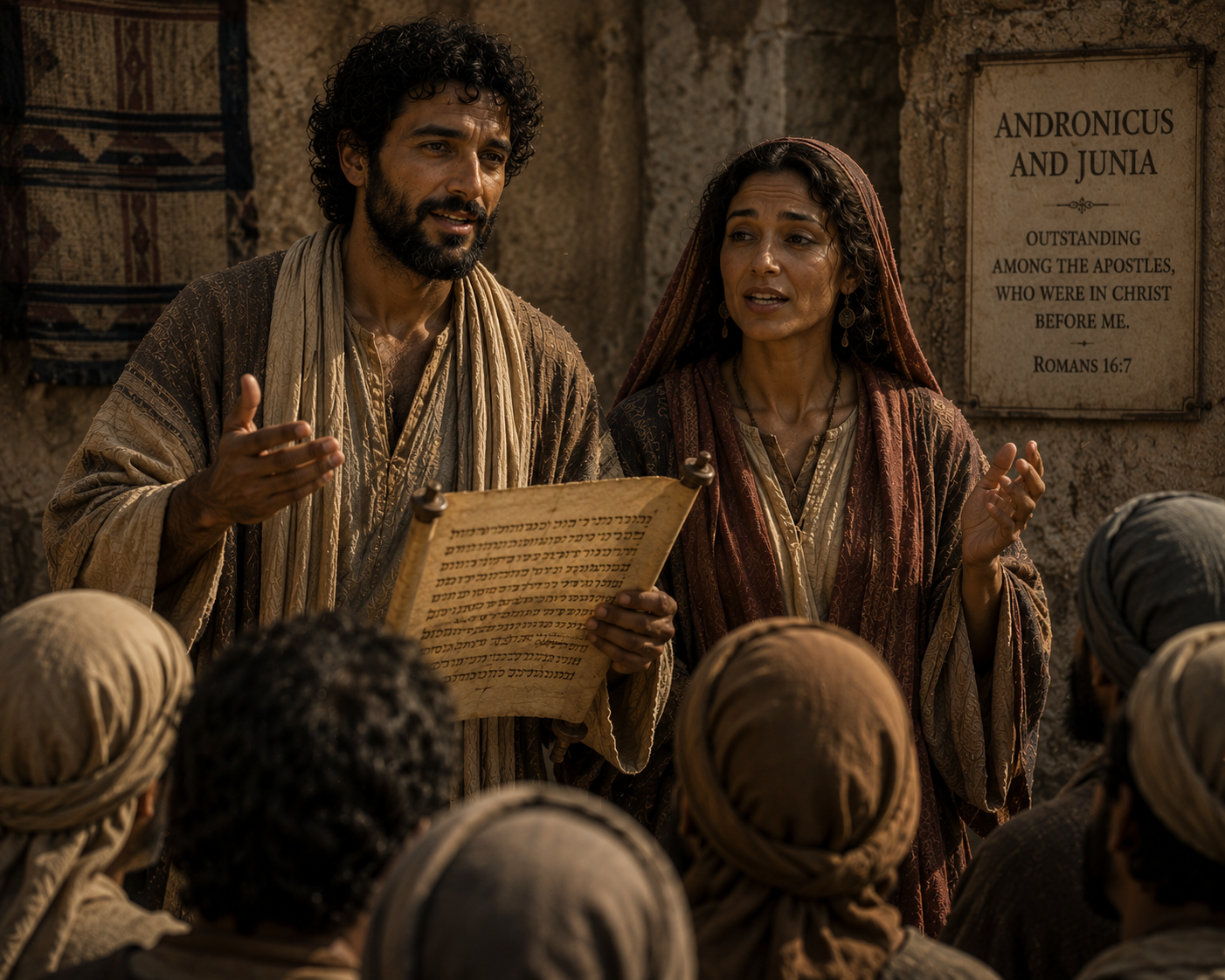
Greet Andronicus and Junia, my fellow Jews who have been in prison with me. They are outstanding among the apostles, and they were in Christ before I was. ~ Romans 16:7
Up until about the 13th century, Junia was commonly accepted as a female apostle based on Romans 16:7. She was even recognized as such within the writings of the church fathers.
In the first century AD, the name Junia appears in inscriptions located in Ephesus, Didyma, Lydia, Troas, and Bithynia, as well on tombstones in and around Rome. A prominent real-life example is a woman named Junia, the half-sister of Brutus, the legendary Roman general. Bernadette Brooten writes: “The female Latin name Junia occurs over 250 times among inscriptions from ancient Rome alone. Further, the ancient translations and the earliest manuscripts with accents support rendering Iounian as Junia.” Peter Lampe made the same claim, and Bruce Metzger agrees that Junia is well attested in ancient literature. The existence of the name Junia in Greek and Latin inscriptions, literature, tombstones, and even as the name of a well-known person, provide convincing evidence supporting the claim that Junia was a common name. The same cannot be said, however, for Junias as a common man’s name. ~ CBE International
As stated in the quotation above, Junias was not a common man’s name in the first century, and there are no known examples of this name in antiquity. It is a name that was later invented to hide the possibility of a female apostle.
The made up name of Junais, was advanced by those who could not accept that a woman could be an apostle. To this day there are some people who still argue that Junia was actually Junias, a man, because of their patriarchal views. It wasn’t until around the 1800’s that the invented name (Junias) began to show up in some Bible translations.
Lynn Cohick points out that the belief that Andronicus and Junia were simply well known to the apostles is not a typical way of reading the Greek grammar, but a forced reading, and a more natural reading is that Andronicus and Junia are actually among the group called apostles.
In the earliest centuries of the church, Junia was accepted as a female apostle. Saint Chrysostom from the 4th century had the following to say:
“’Greet Andronicus and Junia . . . distinguished among the apostles.’ To be apostles is a great thing, but to be distinguished among them—consider what an extraordinary accolade that is! They were distinguished because of their works and because of their upright deeds. Indeed, how great was the wisdom of this woman that she was thought worthy of being called an apostle!”
Saint Chrysostom was a Greek who was fluent in Greek and was raised in Greek culture and deeply immersed in the Greek language. As Scott McKnight says, You can’t get any more Greek than Saint Chrysostom was.
According to Saint Chrysostom, Junia was a woman and was distinguished among the apostles, and the consensus among the Greek and Latin church Fathers support the view that Junia was indeed a woman and an apostle.
There are far more detailed studies on Junia than the one I have offered here, but hopefully this will provoke thought and stir you to do your own research and study.

